
The tools
that turn art
into science.
We don't just make do with what's available — we reimagine what's possible.
You can't have state-of-the-art equipment without the technology to back it up. That's why we stay on the cutting edge of thermoforming science and software.
Our Approach
Here at Hampel, we don't make things. Sure, thermoforming a wide range of complex polymer shapes is part of it, but what we really do is solve problems. Sometimes our customers bring their challenges to us. Sometimes we identify challenges our customers didn't know they had. And sometimes we use our deep expertise in materials science and manufacturing processes to figure out a better and/or less expensive way to do things.
Whether you require turnkey engineering and design solutions, project management or engineering support, Hampel engineers and designers provide the analysis and evaluation that takes cost out of your final product and shortens your time to market. That problem-solving mindset has produced 17 registered patents along the way — with more pending.
Material Expertise
Advances in materials science over the past 15–20 years have opened up vast new realms of possibility — both in what can be thermoformed and in the applications for thermoformed products. Hampel has the experience to work with nearly all thermoformable materials and the expertise to recommend the right one for your project.
Some of the more common materials Hampel can accommodate:
- PE — Polyethylene
- ABS — Acrylonitrile Butadiene Styrene
- HIPS — High Impact Polystyrene
- HMWPE — High Molecular Weight PE
- PP — Polypropylene
- TPO — Thermoplastic Olefin
- PC — Polycarbonate
- PET — Polyethylene Terephthalate
- Cast Acrylic Composites
- Solarkote®
- WeatherPro-G®
- Altair Plus®
- Film & laminates
- Engineered resins
- UL-rated materials
Design Flexibility
The thermoforming process lends itself to an array of materials in a vast selection of colors, finishes and textures. Custom pre-colored plastic sheet can give the final part a showroom-worthy finish, eliminating the need for post-production painting.
Robotic Automated Trimming
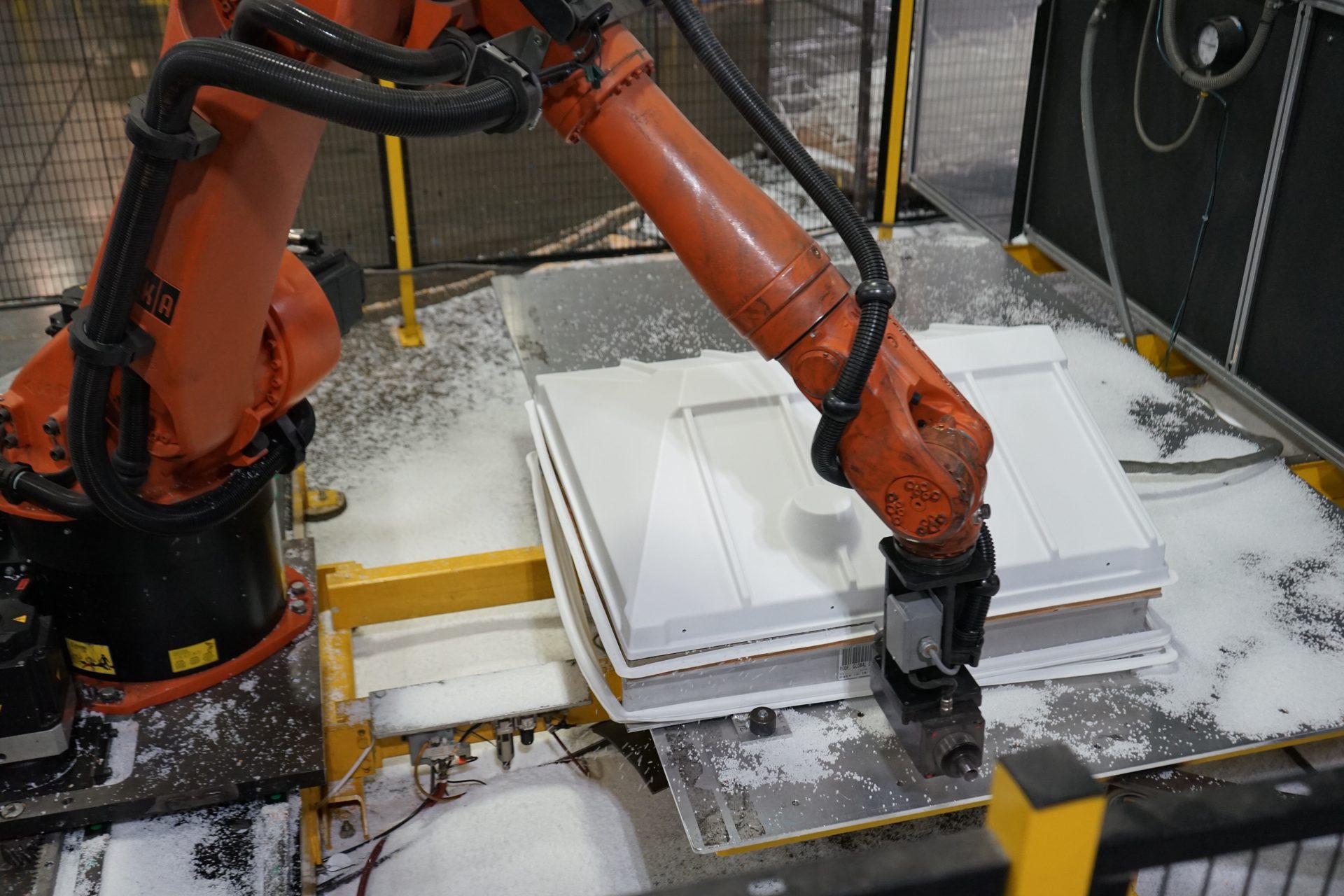
Some companies have a five-axis trimmer. More ambitious ones have seven-axis trimmers. No one had a nine-axis trimmer — no one until Hampel. We partnered with some of the brightest minds in robotic integration to develop the first nine-axis trimmer in North America. They said it couldn't be done. Guess we just didn't hear them.
Our automated trimming equipment trims parts of various sizes, materials and tolerance requirements to exacting specifications and unparalleled consistency. Slots, holes and perimeter trims at nearly any angle can all be accommodated.
Patterns, Prototypes, Molds & Fixtures
A pattern is the first step in tool construction, and can also produce prototypes for design and material validation — the point at which modifications can be incorporated before producing a production tool.
To ensure dimensionally consistent, stable parts, Hampel uses temperature-controlled aluminum molds of only the highest quality, with complex assists, core pulls and moveable inserts for forming complex shapes. We also design and build secondary cooling, trimming and assembly fixtures for each part's unique requirements.
Large-Scale 3D Printing
Additive manufacturing at a scale few shops can match. Our Modix Big Meter large-format 3D printer delivers a build volume of 960 x 960 x 1,000 mm — roughly a full cubic meter — driven by a Griffin ultra-high-flow extrusion head for fast, large-part printing.
We put it to work every day: production fixtures for our forming and trimming cells, rapid prototypes for design and fit validation, and one-off parts that support manufacturing and sales. Big-format printing in-house means faster iteration loops, lower tooling-support costs, and answers in days instead of weeks.
Software
Hampel engineers work in multiple CAD design softwares — and we keep every platform current with the latest revisions. Nearly all file types are accepted — igs, stp, dxf, dwg and more.
Creo Design Software — our base platform for part and tooling design; all tooling design is done to optimize material usage and ease of manufacturing, with full 3-D modeling and simulation.
SolidWorks — our platform for machine design, supporting the custom-built forming and trimming equipment on our floor.
SURFCAM — converts a part model to an actual trim program, downloadable to any of Hampel's automated trim cells.
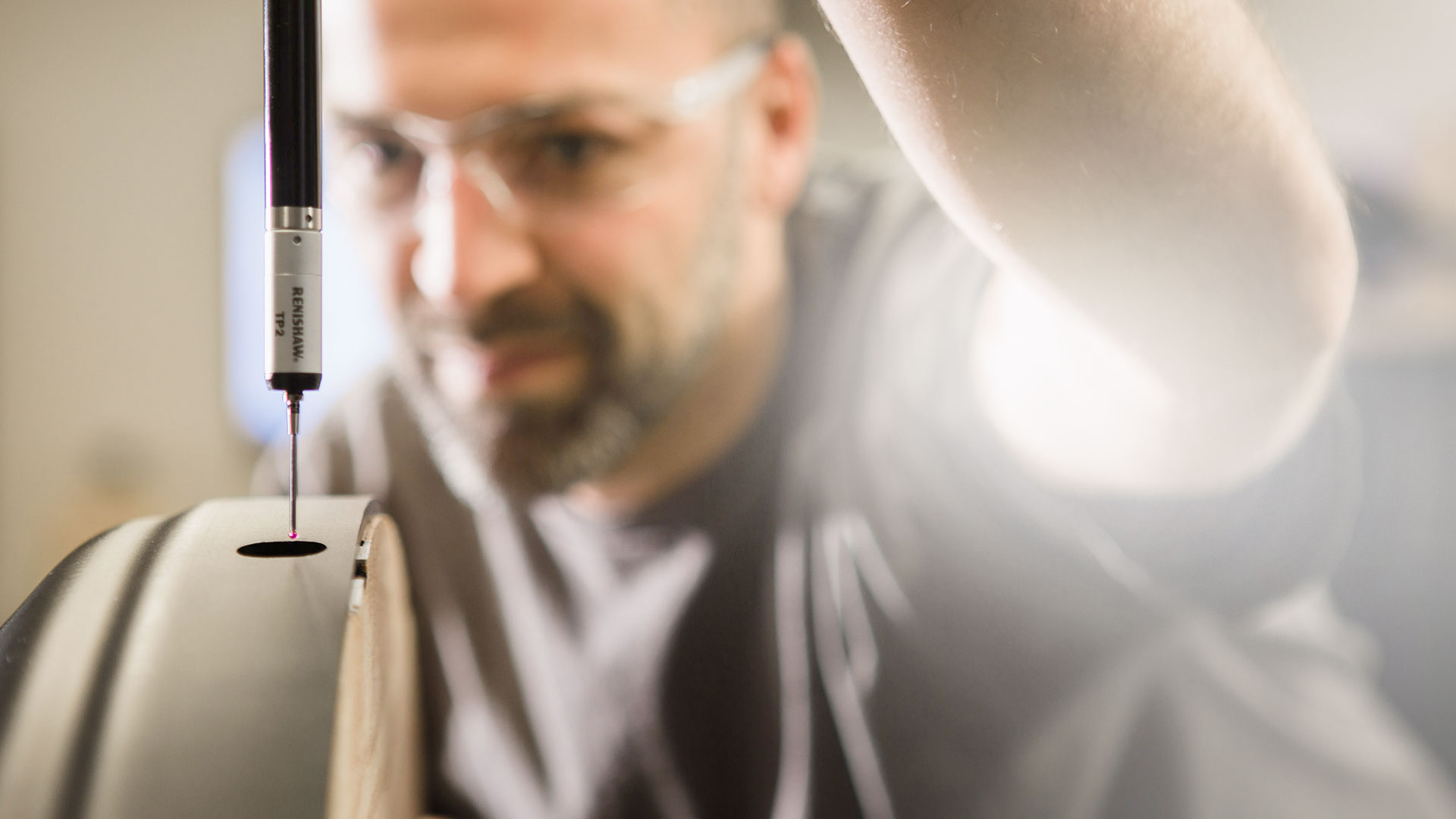
Power Inspect — allows our QA team to provide complete inspection via Coordinate Measuring Machine (CMM), including ISIR, capability studies and PPAP.
 Next capabilityManufacturing
Two ways to start
Have a challenging part in mind?
Bring us the concept. Our engineers will review it for formability and cost before a dollar goes into tooling.